Monday, June 13, 2011

CommanderCast S3E3: The Man in the Mimeoplasm

Posted by ANDY aka GHoooSTS
This week's CommanderCast has Andy and his right-hand man Carlos joined by newcomer Justin, CommanderCast's first DCI Judge guest-commentator and all-around baller. Justin was present for our first call-in show (the second is coming!) and also recently began writing for CommanderCast with his most recent article. I wouldn't be surprised to see Justin join the ranks of CommanderCast regulars as he fits into the show's crew quite well.

This week we're talking about the upcoming Commander product, 1-drops, barriers to entry for the format, and some other odds and ends. Be advised we recorded this on Wednesday last week, and literally saw Kaalia five minutes before recording the segment about new cards. After I finished having a 'joy seizure' and composed myself, we were all quite excited to discuss the ups and downs of the new set. We don't normally talk about unreleased product on CommanderCast, but how many times are we likely to see a product released specficially for the niche subgenre of the game we podcast about? It seemed like the best time to break the rule.

Join us next week where we'll be giving the raw, gritty, hands-on reviews from our initial days of playing with the new product! You can also get in on the action by e-mailing us your experiences with the precons and ideas for taking the new cards in bold and money-making new directions.

As a few quick reminders before you start listening to the show:
  • Season 3 Contest. This one has been awesome, but time is running out! Get your entries in NOW!
  • The Deckbuilding Challenge, in the upper-left corner, has moved on to Phase 2. Have your say!
  • Check out the mid-week update on Thursday. It may be the last (for realz), before mutating into something new and... awesome?
Show notes and links below. Enjoy!


00:00 to 05:05: Intro: Introducing the podcast, your hosts, and a brief rundown of podcast news for the week.

COMMUNITY

05:15 to 06:08: Deckbuilding Challenge: White-Border Only: PHASE TWO ENGAGE. In the second voting segment of the Deckbuilding Challenge, we're picking a colour! Our Commander will be from Portal: Three Kingdoms, one of Magic's most exotic sets ever that just so happens to be white-bordered.

06:20 to 20:18: Free-For-All Roundtable: Commander Tower: One of the spoiled cards for the Commander product, the Commander Tower is a fascinating and somewhat controversial card. Delve into the discussion with this roundtable!


20:25 to 35:38Barriers to Entry: Commander is probably Magic's fastest-growing format. Can I support that statement with evidence? Of course not. But will there be barriers to entry for these new Commander players, and are new ones cropping up? How can we deal with these as a community to strengthen the horde of 100-card deck slingers?

STRATEGY

35:48 to 58:18Archetype Rundown: Ramp: A focused discussion on the ramp archetypes, broken down into both Artifact-based and Land-based. Why play these, and how do you fight them? Similar to our past segments on these subjects, but unique as we examine the two subsects of Ramp-style decks in parallel.

TECHNOLOGY

58:31 to 1:09:28: Curving Out: 1-Drops: In a new series, we're looking at points on the mana curve and suggesting some cards for them individually. Dialing things back from our discussions on Ramp strategies, we take things back to the foundations of MtG with the simple, yet oft-overlooked one-drop. In Commander, a card with a CMC of one needs to be truly awesome to hold up to a format where colossal-cost bombs are thrown throughout games. We each pick a creature and non-creature CMC one spell to put on a pedestal.

Andy's Picks:
Mystic Remora and Entrails Feaster
Justin's Picks:
Voyager Staff and Spikeshot Elder

Carlos' Picks:
Exploration and Weathered Wayfarer


1:09:40 to 1:11:14: Preview Card Hype Session: We take a look nat the upcoming Commander sets, examining the cards that excite us, take a brief detour into Hater Country to rag on what doesn't work for us, and then swing back into pure, unfettered glee to talk about the Commanders we can't wait to put our filthy hands on.

Carlos' Picks:
Non-Legendary Card of Choice: Acorn Catapult
Biggest Disappointment:  Ruhan of the Fumori
Favourite Commander: The Mimeoplasm


Justin's Picks:
Non-Legendary Card of Choice: Hydra Omnivore
Biggest Disappointment: Karador, Ghost Chieftan
Favourite Commander: Kaalia of the Vast

Andy's Picks:
Non-Legendary Card of Choice: Mana-Charged Dragon
Biggest Disappointment: Basandra, Battle Seraph
Favourite Commander: Kaalia of the Vast

1:41:47 to closing: Outtro.

PERTINENT LINKS
CONTACT INFORMATION
  • General show contact/E-Mail Andy: CommanderCast(at)gmail(dot)com
  • To E-Mail Carlos: cag5383(at)gmail(dot)com
  • To E-Mail Justin: jagteq(at)gmail(dot)com
  • To Tweet Andy: (at)CommanderCast on Twitter

Thursday, June 9, 2011

Mid-Week Update: June 9

Posted by ANDY aka GHoooSTS
Oh snap! This week has been a blistering inferno of Commander-related hotness. We've been getting spoiler cards left, right and centre, to the point it threatens to overwhelm me. No, seriously. Carlos and Justin were there when I first saw Kaalia. I pretty much went into a 'joy seizure' and it took a few minutes to compose myself. It's not that every card is spectacular, but some are almost ridiculously exciting.

To keep that excitement moving, we have a new writer here on CommanderCast. It's Matt, who has been an editor for a full season and is throwing himself at y'all with his 'True Conviction' series. In this article set, he'll tackle major, controversial format issues. I am quite glad he nonchalantly mentioned he might want to write some time, because I'm pleased with the results.

Also, don't forget to check out these affiliate links for the week in the event your Commander fiending is getting out of control:
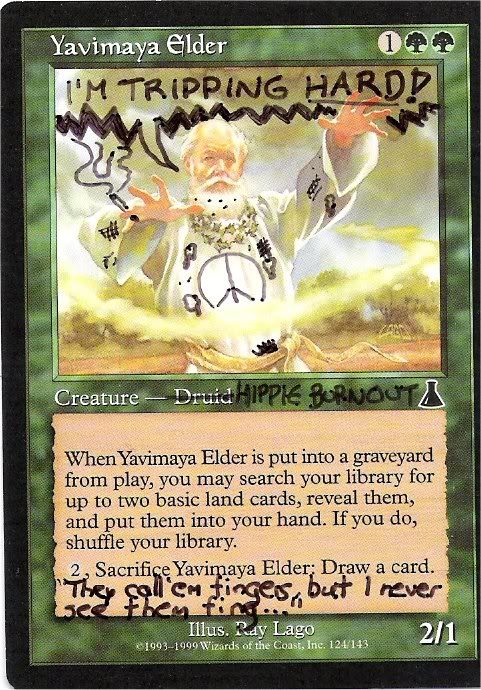
Also, be sure to check out the Season 3 Contest while you're here. Sharpie alters are serious business, and can result in some serious prizes courtesy of my man Derfington. There's still lots of time to work up your masterpiece, but don't procrastinate and be left thinking "I missed the episode six deadline. Now all I have left is these markers to sniff".

Here's the premiere article for "True Conviction". Enjoy!

True Conviction 01 - Tutor Generals Kicked My Dog
By MATT

In a tiny cul-de-sac at the end of Mirrodin Lane, the peaceful residents of Multiverseville celebrate Karn Liberation Day, a midsummer’s reprieve of jumping through neighbors’ sprinklers and sharing bean casseroles as well as PG-rated jokes and stories, commiserating and rejoicing in the spirit of the day.

Kresh tosses a FrisbeeTM to his neighbor, Hanna. Shirei gets his kite stuck in Doran for the twenty-seventh time that day. Jhoira remarks, sipping her eighth beer, “If only I could suspend this hangover forever!” Everyone laughs. All is well in Multiverseville.

The moving truck rumbling down the block towards them goes unnoticed at first, the euphoria of the day intoxicating them too much to immediately register the realization that they’re about to have a new neighbor, and that their lives will never be the same again. The truck backs into the vacant house opposite of Teferi’s residence, beep, beep, beeping as it does. Everyone goes silent, unable to quell their curiosities as they stare at the truck now parked in front of the green-painted house with the white-washed picket fence.

The door to the truck opens violently, and it’s alarming to some, striking at their cores menacingly. Two legs appear beneath the door—soles thudding on the pavement—clad in knee-high, brown pirate boots. Feet pivoting, the figure slams the truck door shut, and many gasps pierce the silence at the shocking sight of the new resident, a young, busty brunette woman clad in a scandalous sort of red bikini-top. She flashes a sideways grin, surveying her new neighborhood through furtive glances left, then right.

Ib Halfheart’s pet hound Isamaru goes wild, barking obscenities at the newcomer. Nothing had ever before worked up that dog like this, and so everyone was all the more surprised when he bolted across the street at full force, as if to tear the mysterious lady to shreds.

The dog leaps at her as soon as it’s in range, but she intercepts the furry little thing in the air with a mighty boot, launching the dog back across the street to where it came, its limp body bouncing thrice before skidding to a halt near its owner.

Ib howls on behalf of his downed dog, running to the little thing to hold him, “She kicked my dog!” Shocked, appalled, and in disbelief, the people of Mirrodin Lane begin murmuring amongst themselves.

“She’s a bad apple, that one.”

“Well, she was only defending herself…”

“How can anyone do that to a poor little creature?”

“My God, maybe dogs CAN sense evil.”

“Why are we in a 50s suburban stereotype?”


If this sounds at all familiar to you, then you’ve probably unwittingly welcomed someone into your playgroup who insists on playing a general that rubs you the wrong way, but you can’t quite put your finger on why you feel that way. It’s like someone new joined your book club, and this person shamelessly shows up with the Wikipedia article instead, boasting about how they didn’t even read the book, declaring “it’s faster this way” with a subtle undertone of “haha, suckers.”

Oh, you try to tell yourself that the person is just “different” and that maybe you’re being unjustly intolerant whenever the nagging suspicion that what they’re doing is wrong claws at your mind—but deep down, you know that your rage is justified. You know it in your soul that this person and the General he or she brings to the table aren’t good for the community, and their subversions shouldn’t be welcomed. You know that this individual is just plain “missing the point,” but you don’t know the right words to voice your discomfort on behalf of the group.

I know just what you can tell that individual: “Hey JERKOFF, why don’t you stop playing Tutor Generals?”

If you don’t pay as much attention to the wardrobes of the characters in the magic cards as I do (like, omg, did you see what Akroma wore on the red carpet at the Webby’s??), then I’ll just come out and say that the dog-kicking general in the above dramatization is Captain Sisay, one of a handful of the Generals with a Tutor ability—that is, either a triggered or activated ability that allows you to search for a card from your library. Oh yes, that’s as absurdly powerful as it sounds, and there’s a good reason why the very mentions of Godo, Bandit Lord, Captain Sisay, Momir Vig, and especially Zur, the Enchanter have caused countless players to make early trips to their underwear drawers.

Alright, that’s the end of the sartorial humor from me, I promise. Now, onto serious matters: systematically explaining to you why you’re a bad person for playing tutor Generals.

But first, before we proceed, you must acknowledge the following as absolutely true: There is a clear and absolute division between playing competitively and playing casually, and we will not make sweeping value judgments on which is the correct way to play. However, for the purposes of this argument, we’ll consider the original vision of Commander, which consists of group games that promote positive social interaction. In other words, we’re not concerning ourselves with win percentages. If we were, this article would be titled “Tutor Generals Saved My Cat from a Tree,” featuring Sisay, the earnest Captain of the Fire Fighting team.


Missing the Point

Let’s play the numbers game for a moment. In traditional, tournament-sanctioned variants of magic such as Standard or Legacy, players are tasked with making 60 card decks, which is the required minimum size and thus the optimal number to attain the ultimate goal: consistent gameplans that yield the highest win percentage.  In this standard setting, deckbuilders are allowed four copies of any legally permitted card in whichever format of Magic they’re playing. If my math serves me correctly, that means that there’s a 600,000% chance that you’ll draw into whatever optimal card you put into your deck, making each game play out roughly identically.

Commander, on the other hand, is a singleton format where you have 100 different cards including your Legendary general. A format of this nature’s inherent design dictates that players must have multiple game plans, a lack of consistency otherwise seen in competitive Magic and creative innovation in finding less-than-optimal card choices to round out your deck. This describes 95% of the Commander decks out there; decks that don’t “rub Commander players the wrong way.”

Consider the 5% of decks who are commanded by a Tutor General. Almost always having access to a permanent that allows you to routinely undermine one of the core design features of this format is an unwelcome perversion to the vast majority of players. These players have either completely converted from standard magic or are at least seeking a break from the cutthroat environment of consistent gameplans and samey decks. Neither of these two characteristics do not and should not define a format that cropped up in opposition to the standard trends in magic.

That is, the majority of casual players who are attracted to Commander place a great deal of value on expression and innovation, design elements that are not only self-rewarding but are pleasing to a group’s sensibility. Humans have a natural, positive reaction to novelty—so says I and social psychologists, anyway. Contrast this to a standard environment, where expression and innovation are actively chided and belittled by the hearty experts, barring those infrequent circumstances where someone’s innovation strikes gold in resulting in a deck with a higher win percentage.

But again, Commander players don’t place value on win percentages, or at least they don’t value winning over the other concerns of Commander culture: expression and positive social interaction.
Duh, Winning!

Playing with a consistent tutor mechanic breeds decks that are designed to win first and begrudgingly hold back powerful plays so the groans around the table become less deafening second. For those who opt to make decks with consistent, one-track gameplans first, there’s inevitability at work in the disregard for the level of positive interaction expected in a free-for-all format. Playing a tutor general is an affront to the format, and is tantamount to saying, “Actually, guys, I
really wanted to play Archenemy instead.”

What I mean by “holding back power” is the concession that many players who miss the point of EDH try to make in feeling out how much they can get away with in their group without getting the boot. When playing a Tutor General, you’ve more than likely crafted a gameplan that consists of nabbing pieces out of your deck in a specific order, playing a toolbox-style deck that either locks down or combos in a handful of turns (something far more akin to a standard deck’s goals). Holding back in this setting means making knowingly sub-optimal plays to appease the group, which players rightly intuit as insincerity. If you’re packing antisocial cards and your group knows it, then at least have the courtesy to use them.

Insisting on playing Tutor Generals in a group will pervert that group, mark my words. Any format in Magic yields an arm-race, true, but nothing has been more immediately dangerous to the variety and, indeed, the well-being of Commander than those players who bring decks to the table that are designed to win better and faster than the decks around them, and with generals that give them the absolute advantage necessary to do so. Winning is discouraged in Commander if that is your deck’s primary goal, but you’ll see a lot of deckbuilders adapt similar mentalities to those with Tutor Generals if they even hope to survive to the mid-to-late game, where the majority of Commander decks want to be.

I don’t mean to imply that your decks shouldn’t have win conditions, or should be sup-optimal. What I do mean is that tutor generals have a distinct Tier advantage in affording their controllers consistency whereas the rest of the table is falling behind both in their assuredly less-consistent gameplans and, generally, in card advantage. On top of this, tutor decks are discussed ad nauseum on the internet, and it’s almost inevitable for its pilot to seek out the these discussions and thus the absolute best cards for his toolbox, resulting in increasingly more brutal, anti-social pieces to survive the immediate 3 v 1 situation that ensues when generals are revealed.

It’s a vicious cycle when the tutor player feels obligated to remove Jareth, Leonin Titan from his deck and replace it with Iona, Shield of Emeria to have more firepower to survive the three-player alliance whose aim, every game, is to eliminate you first.

I should know; I’ve had a Captain Sisay deck for years.
There Goes the NeighborhoodIf we accept the natural arms-race nature of a collectible card game that has over 11,000 cards to choose from and that some cards are far better than the others, then we can at least take comfort in the fact that most of the powerful and difficult-to-answer staples in Commander are happened into—for the most part—at random. Or, at least, we know that most decks do not have virtually unlimited tutor capacities, and thus we do not need to have virtually limitless answers to the immediate threats and combo pieces that are tutored up.

This comfort and, in fact, balancing-principle of singleton, 100-card Commander is undermined by Tutor Generals, who are able to over-centralize games on some of the most difficult-to-answer and environment-warping cards in Magic. I understand that these types of frustrating cards don’t define every tutor deck, but there’s little denying that the sheer consistency factor (and the sense of dread this factor elicits in a group) sets these decks apart and in a way that isn’t in line with the vision of the format.

But for those deckbuilders that do attempt to adapt their tutor decks to handle a triple onslaught, their decks very often become what is known as “prison-style” decks—so-called, I imagine, because they’re about as fun to play against as being cornered by Crazy-Eyed Joe in the prison shower. If you’re confused about the sort of cards I’m talking about, I’ll list a few (try not to cringe): Gaddock Teeg, Stasis, Tangle Wire, Ghostly Prison, and Linvala, Keeper of Silence.

And whether you’re setting up your tutor engine on turn 4 or turn 8 isn’t the issue here; games have a sort of gloomy, helpless ambience about them when you’ve grown accustomed to playing against Tutor Generals, whose inevitability will win out in the end and make each game overly familiar. Games lose their sense of mystery and variety in this setting, and you find yourself in constant desperation mode, hoping you’ll top-deck the tiny handful of cards you have in your deck to deal with the tutor menace, gradually telling yourself that you have to adapt to be faster and more consistent, and one day, perhaps, giving in.

It may never occur to you, long after that day, that the reason you no longer enjoy playing Commander is because of the way you allowed yourself to adapt, but you have this odd sensation to play Standard again, because it seems to have a healthier and more varied meta than this one. You may even have the impulse to Dragon Punch that Sisay player, but you can’t quite pinpoint the source of your rage.

Well. Now you know.


It’s been one year to the day since Sisay moved in to the only house on the block with a fence around it, a once quaint and endearing picketed fence that now looks more to its neighbors like ominous pikes, a jarring sort of partition that would have once seemed out of place in the neighborhood. But Mirrodin Lane is a shadow of its former self.

Teferi’s house has been long-since abandoned, as Sisay’s best friend, Iona, has taken up residence within her green-painted lair, and Iona somehow charmed the city council into banning all people of Zhalfir-descent from the neighborhood.

The corrupt mayor, Sisay’s friend Gaddock Teeg, had suddenly taken an interest in setting restrictions on any and all commodities deemed “exorbitant,” and thus many residents had to watch, dumbfounded, as their above-ground pools were leveled by city bulldozers, their pool tables and riding lawnmowers confiscated, too.

Meanwhile, the city councilman Linvala, yet another friend of Sisay’s, had taken away the residents’ ability to protest any changes in a swift coup of the former politician, Azami, dooming them to a life as restricted prisoners in what was once a frivolous, jovial neighborhood with so many freedoms.

This day used to bring out the best in the people of Mirrodin Lane. It used to promote good-spirited playfulness and camaraderie. But now, on this day, in the thrall of Sisay’s influence, the people are apprehensive to even set foot on their own lawns. All but Sisay herself, that is, whose lying languidly on a lounge chair, sipping a margarita.

She remarks, “I love this neighborhood.”

But no one is there to hear her.

Monday, June 6, 2011

S3E2: Losing More Than A Game

Posted by ANDY aka GHoooSTS
So I was reading my Twitter feed and this guy, Chris Landsdell, kept hinting (occasionally just saying) he wanted to be on CommanderCast. So you know what I did? Asked him to come on the show. Of course, this wasn't a typical invite with a week or so's notice; instead, me, Carlos and Donovan were like "shit" when the fourth guy didn't show up. So Chris parkour'd through the internet into our Skype discussion and within minutes, we were doing our thug thizzle laying down the podcast I present for your listening pleasure today.


If you are not familiar with the works of Mr. Lansdell, I recommend you investigate them; the toils of his authorship are readily available on Mana Deprived, and his podcast Horde of Notions can be found by following the link. Both should provide with an idea of what Chris is all about and hopefully leave you informed and entertained.


Anyway, this week's battery of topics was rounded up in a five-minute Skype scrum loaded with sexist jokes, gay innuendos, and Simpsons references, so you know this is another quality episode of CommanderCast. I'm glad you guys keep coming back.


Also, don't forget to vote on the Deckbuilding Challenge in the upper-left corner and get your sharpies out for the Season 3 Contest!


Show notes and links below. Enjoy.

00:00 to 03:05: Intro: Introducing the podcast, your hosts, and a brief rundown of podcast news for the week.

COMMUNITY

03:14 to 14:54: Free-For-All Roundtable: Poison Round 2: Back in Season One Episode 4, we did a Roundtable on poison, ultimately deciding we should probably wait and see what the completed Mirrodin/Phyrexia block brought to the table. Now we have all those tools. How do we feel about Poison in Commander?

14:05 to 17:05: Spotlight: CMDRDecks: If you remember the Deckbuilder's Spotlight in Season One of CommanderCast, this is something similar and better. CMDRDecks is a YouTube channel that updates every Friday with videos of deck rundowns sent in to the administrator. Give them a look in you're into this kind of thing, the content is some of the best of this kind out there.

17:15 to 36:42Growing Your Game: Based on Chris' recent article, we talk about growing the game. Hopefully nobody is listening to CommanderCast and not playing Commander due to a lack of local players, but it can never hurt to have more. In this segment, we discuss how to encourage growth of your local scene and the tools you have at your disposal for this. We also touch on building an online playgroup that everyone finds mutually agreeable, and generally talk about how to serve as an ambassador for Commander.

STRATEGY

36:53 to 53:58Archetype Rundown: Token Swarm: We're talking about how to play a Token Swarm-type deck to overrun your opponents with a crush of tokeny mans. Why bother with this archetype? Where will they fare well, and what are the weaknesses? Which decks give a Token deck the most trouble?

54:12 to 1:07:07: False Idols: 1-for-1s are Bad: Tearing down another of  Commander's false idols, this week we're ripping the notion 1-for-1s are bad to shreds. Spot removal and the like are commonly looked down upon for not supplying card advantage, but they also serve a vital role that some people are seemingly losing sight of. Listen to this segment, and start putting Nature's Claim in your decks.

TECHNOLOGY

1:07:20 to 1:20:14: Technology: Secret Tech: Chris Edition: You know it, you love it. Secret Tech is back up in this bitch.

Chris' Picks:
Common: Armillary Sphere, Sprout Swarm, Whitemane Lion

Uncommon: Return to Dust, Treacherous Urge, Clutch of the Undercity
Rare: Phyrexian Rebirth, Planar Portal, Radiate

1:20:28 to 1:39:14: Technology: Humiliating Losses of Chump Cards: Sometimes you lose a game. Sometimes, you also lose a bit of dignity in the process. Listen as we form a tear-soaked support group over our losses to embarrassing cards.

Donovan's Humiliator: Dust Corona
Andy's Downfall: Leechridden Swamp
Chris' Dominatrix: Uril the Miststalker (?)
Carlos' Harbinger of Failure: Sorrow's Path (OH NO...)


1:39:51 to closing: Outtro.

PERTINENT LINKS
CONTACT INFORMATION
  • General show contact/E-Mail Andy: CommanderCast(at)gmail(dot)com
  • To E-Mail Carlos: cag5383(at)gmail(dot)com
  • To E-Mail Donovan: donokun(at)gmail(dot)com
  • To E-Mail Chris: lansdellicious(at)gmail(dot)com
  • To Tweet Andy: (at)CommanderCast on Twitter

Thursday, June 2, 2011

Mid-Week Update: June 2

Posted by ANDY aka GHoooSTS
Hot on the heels of Season 3's premiere, we have our mid-week update keeping y'all posted on what's going down with our affiliate mans. If you're always looking for more Commander goodness to ravenously consume, then this should serve as a buffet on which you can gorge yourself for some time. In our absence, the affiliates have been productive, and we're just belching these articles out in one giant, satisfying release so that you can peruse them at your leisure.


AFFILIATE MANS AND THEIR WORKS
In other news, in case you didn't hear, Sol Rings will be in every Commander precon product and Lightning Greaves was also spoiled as part of the set. The first bit is kind of a big deal; the second part is pretty cool too.

The Sharpie Alter Contest is in full swing. Check out the rules and start ruining cards for fun and profit. Also, don't forgot to vote on the Deckbuilding Challenge in the upper-left hand corner of this site.


This week to kick off the season's mid-week updates, we've got a fresh face on CommanderCast; it's Justin. He made a cameo in the live episode and now he's dropping science on our site as one of our new authors. Justin's series will be devoted to providing new players a road map to entering the fray of EDH. From deciding on the structure of your new deck to individual card choices, he's going to have the hookup for newer players and scarred, miserable MtG veterans hoping to get into Commander.


Deck Focus
By JUSTIN

When I first started playing Commander, my decks sucked. They sucked big time. The worst part was not that the decks weren’t good, but they weren’t even much fun to play (which is the whole point, isn’t it?). But through much trial and error, I’ve figured out how to get the most out of my deck ideas and themes, and that’s what I’d like to help all of you with. My goal is to give you all a glimpse into how I approach deckbuilding, which is really about turning concepts and thoughts into finely focused deck lists. 


Focus is one of the most important parts of Commander deckbuilding since the card pool is so large that the process can feel understandably daunting, especially when you’re just starting to build a deck. That feeling can be even worse with Commander since, in addition to the size of the card pool, you’re having to look for 60+ separate options instead of just maxing out on 10-20 best options like you might in other formats. Hopefully, this look into deckbuilding will help you refine your own decks and deckbuilding process so that you can have fun in Commander doing what your deck is trying to do!
   
Generally Speaking

So, where do you get started with building a Commander deck? Often, that hurdle is what discourages players from delving into the format. When you have virtually every card in Magic to work with, how can you possibly narrow down thousands of choices to just the hundred cards that you want to play with?  


From my experience, there are two main places where an idea can start: a great General or a great main theme. Either of these starting points can lead to a fun deck that serves you well for years. Two of my oldest decks represent each of these starting points, with my Verdeloth deck built around the General and my Bant-colored deck singularly focused on a theme (but having changed Generals a few times already). Whichever route you decide to go, it is absolutely critical to have a theme to your deck, something which ties the deck together and makes the whole thing really click.  


A great main theme can mean a lot of things. It can be as broad as “making tokens” or as narrow as “Octopus Tribal.” Your theme is going to give you some focus to start your deck and help you look in a direction to take it. Obviously, your deck will have lots of variety and won’t be completely single-minded in its plan, and the theme that gets you started won’t always be the theme that your final product is built around. That Octopus Tribal deck isn’t going to get you very far as a main theme when you realize that your deck will have a grand total of two non-Changeling creatures in it, one of which has no abilities. In fact, I’ve often had ideas for the main theme for a deck that ended up being secondary supporting themes to something else. The important thing is that the theme idea is going to be the kick that gets you started.  


But wait! How will you know if your theme is one that can be the backbone of a full deck, or if it is better suited as a supporting theme? There are a couple of key things to look for in a theme to make sure it can form the basis of a deck:


1. Focus:  
Your theme needs to achieve something. For your theme to really be the core of your deck, you want it to be doing something. It doesn’t even really matter what that something is, whether it’s playing a ton of crazy rules-bending enchantments like Eye of the Storm and Hive Mind or playing a group hug strategy with New Frontiers and Font of Mythos or even just straight-up suiting up some creature with Swords and other equipment and smashing face.  


One thing to keep in mind, however, is to maintain a somewhat narrow focus. The whole point of your theme is to narrow down the list of cards you’re looking at, so it doesn’t really help you if your theme is too broad. One of my earliest decks was built around attacking as a theme. This theme was problematic because, although it seemed fairly straightforward, just focusing on “attacking” was too broad a theme. I would have a myriad of cards that triggered on attacks or did things when I attacked or gave me more guys to attack with, but none of those things really helped the deck do what it wanted to do. To be honest, I didn’t even know what the deck wanted to do, which probably should have been the first sign of a problem. Whatever your deck wants to do, at least make sure it has some kind of focused plan.


2. Size:  
Your theme needs to be large enough to support the whole deck. While narrowing down your options is important, you still need enough cards to make a deck. I once had a deck idea based on attacking with Planeswalkers. Unfortuantely, there are only about 4 ways to turn Planeswalkers into permanents that you can then turn into creatures. As awesome as it is to attack with Nicol Bolas and Nicol Bolas, Planeswalker, that theme isn’t going to be headlining a deck for a while.  


The exact definition of “large enough” isn’t set in stone, but at least 10 cards are necessary to make sure you’re seeing at least a couple cards from your main theme every game. After all, it’s probably not accurate to say that your deck is focused on a particular theme when it can go an entire night without seeing the theme cards that it’s built around.


3. Synergy:  
Your theme’s cards need to at least work well with each other. One of the big difficulties with building a “good stuff” deck that is actually good is that the power level of the individual cards is very high but the cards don’t necessarily interact well with each other to form a cohesive deck.  Power cards like Bribery, Tooth and Nail, and Insurrection are all very strong cards, but they aren’t particularly stronger playing with each other than they are independently.


More importantly, without thinking about it, it’s very easy to include powerful cards that actually detract from the power of your other cards. Necropotence, for instance, is an extremely powerful card drawing engine, and Survival of the Fittest is one of the best search engines in the game. However, since Necropotence exiles the cards you discard for Survival, it actually makes Survival weaker by stopping itself from running the recursion the deck usually thrives on.


4. Supportability:
Your theme should have some other cards to make the deck better because it was running that theme. Even otherwise generic Tribal themes are OK because they can run some universal cards that benefit them because all their creatures are the same type. However, it is this factor, that makes the more widely supported tribes more powerful, like Elves and Goblins, since they have much more focused cards that are generally not that good but are excellent when you have a critical mass of appropriate creatures.  


It is important, though, to make sure that you have effective support cards for your theme. Let’s say that you want to theme your deck around shroud creatures. Most creature decks can easily be supported by Equipment or pump spells, but none of these boosts work for most shroud creatures since their core ability stops you from helping them in combat. It’s important that you can support your theme before you center your deck around it.


5. Power:  
Your theme should actually do something to advance you toward winning. This is admittedly not as important if your goal isn’t to win the game, but most decks will actually want to try to win, so for them this factor is important to keep in mind. For example, let’s suppose you really like Boomerang effects and want to build a bounce deck. There’s obviously plenty of bounce spells you can play, and they work well together to create a web of permanent control.  


The problem, though, is that if your deck has nothing but bounce spells in it, you’ll have almost nothing that lets you win the game (a lot of bounce effects are spells rather than creatures, and the creatures are often not going to attack all that well), and your spells will only keep your opponent behind rather than pushing you ahead. Reactive themes like this can be very powerful, but they will often slot in better as supporting elements to a deck built around a different theme.

Now, that’s all well and good, but how do you come up with a theme in the first place?  The theme might come from a particular deck style, a particular combination of cards, an old deck you used to play in tournaments, or even a single card that you just have to play with.  The germ of a deck idea can come from anywhere, but let’s start with the most obvious one, given our chosen format: your General.

A Trip to the General Store

One of the best ways to get started on your Commander deck is simply to find a General. The General is probably the most unique aspect of Commander as a format, and it is a rich and interesting avenue for deck construction. Using your General as your starting point serves a couple of functions. First, it determines your colors, which immediately narrows down your card pool, whittling away at the huge amount of options you have to weigh.  That alone might be all that you need to get started. Second, it will often give your deck a direction and theme to follow. Your choice of General will help you here since your General’s abilities will help dictate what cards will go well in your deck.  

One of the simplest ways to get started on a Commander deck is to pick a General that you can build around. Having a card that you are (usually) guaranteed early and frequent access to during a game is extraordinarily game-changing and allows you to build around your General in ways that other singleton formats don’t. Moreover, many Generals lend themselves quite well to being built around.  

For instance, Wort, Boggart Auntie is a General that’s pretty straightforward, but extraordinarily powerful as the General for a Goblin Tribal deck. A deck like this is pretty strong and synergistic, and it’s also pretty easy to get started at building it;  you can just start with all the red and black Goblins and go from there.  

Experiment Kraj is another example, as it clearly wants to be played in a deck with lots of +1/+1 counters and creatures that benefit from them. This simple starting point can lead you in all kinds of cool directions, from creatures with +1/+1 counter-centric mechanics like Phantom Centaur, Spike Weaver, and Cytoplast Manipulator to proliferate cards such as Inexorable Tide. If you’re having a hard time figuring out where to start your Commander deck, Generals like these can be a great way to get into the format.

However, it’s not necessary for your General to be such a single-minded card to build around. Many Generals have a lot of different ways to build around them, and you can quite easily use any, all, or even none of the obvious build strategies if you want. This method is very useful if you have a more generic theme and want to find a General that works well with it. You can also just find this kind of General and use it’s abilities to guide your thoughts into what kind of themes it wants you to play.  

A great example of this type of General that I’ve played for a while is Godo, Bandit Warlord. His abilities clearly lean toward killing opponents with General damage since he gets to attack twice each turn and gets a free Equipment for himself. You can also play a more controlling deck with a toolbox of Equipment for your other creatures. The deck can also be a more aggressive build with lots of multiple-attack-step cards like Savage Beating or Aggravated Assault. Godo’s ability affects Samurai in addition to just himself, so you can even start a Samurai Tribal deck around him.  

Now, these themes are obviously not all created equal (go ahead and do a Gatherer search for Red Samurai. I’ll wait.), but the great thing about Commander is that you can feel totally free to try all the avenues and not worry too much about how good the themes are. I tried to fit all three into my Godo deck, and, although the Samurai tribal theme has fallen by the wayside, it did lead me to find several hidden gem Samurai (Ronin Cliffrider is probably my favorite) that I would otherwise never have thought to play.

Of course, your General doesn’t have to be the centerpiece of your deck. A lot of decks, particularly the typical “good stuff” decks, only use their General to determine their colors. There’s certainly nothing wrong with that, and depending on your color combination, there may not be a General that allows you to play the colors you want and also does something interesting for the deck you want to play. This is especially true (for the moment at least) of the “enemy wedge” combinations that pretty much have to play the Planar Chaos dragons like Intet and Vorosh, but enemy color decks in general have fewer options to choose from.  

However, be careful when building a “good stuff” deck that you still have some kind of theme or focus. Even if you’re just using your General for its colors, make sure your deck has some semblance of a game-plan to take advantage of the unique gameplay elements that this variant format affords.
   
Wrapping It Up

I’ve been rambling quite a while here, and we haven’t even touched on how to build your manabase or how to whittle down your theme or themes into a 99-card masterpiece. While I do have a lot more to say on those and other topics, I’m going to have to save that for another time. For now, I just want to leave you with this thought: however you’re building your Commander deck, make sure you have a game-plan and cards that play well together for that plan, because, if you don’t, your deck will be unfocused. If that’s the case, you won’t have as much fun, and that’s really what we’re all in this for, isn’t it?

I hope you found this advice useful. Stay tuned for part 2, where we’ll talk more about trimming your theme down to those final 99.

Also, as kind of an aside, I haven't fully decided on a name for this article series as of yet, so I thought I'd ask the readers/followers of Commandercast to help propose ideas!  Send any article series names along with your feedback and we may choose yours!

Justin
jagteq(at)gmail(dot)com